Why Edibles Hit Different: Understanding the Science Behind Cannabis Consumption |TheeSmokahontas Tymes Piece
Volume 1 | Cannabis Science Series
Reading Time: Approximately 12–15 minutes
Difficulty: 🟢 Beginner
Evidence Badge: 🟢 Strong Evidence
"Understanding cannabis isn't about finding the 'best' way to consume it—it's about understanding why different methods produce different experiences."
What You'll Learn
By the end of this article, you'll understand:
- Why edibles affect the body differently than smoking or vaping.
- What happens to THC after you swallow an edible.
- Why onset times vary from person to person.
- How 11-hydroxy-THC contributes to the edible experience.
- Common misconceptions about edible cannabis.
- Practical considerations for responsible consumption.
Why This Matters
Whether you're new to cannabis or have years of experience, you've probably noticed that no two people seem to respond to cannabis in exactly the same way. One person may feel relaxed after a modest edible, while another may find the same dose overwhelming—or barely notice any effect at all.
These differences aren't simply a matter of tolerance. They reflect the remarkable complexity of human biology. The way cannabis enters the body changes how it is processed, how quickly its effects begin, how long they last, and, in many cases, how those effects are experienced.
Understanding these differences can help consumers make more informed decisions, reduce the risk of accidental overconsumption, and better appreciate the science behind cannabis.
Introduction
When people talk about cannabis, they often focus on strain names, THC percentages, or whether a product is labeled as an indica or sativa. Yet one of the most important factors influencing the experience often receives far less attention: how the cannabis is consumed.
My own curiosity began after noticing a consistent pattern. Although I had tried multiple methods of consumption over time, I found myself repeatedly returning to edibles. They provided a longer-lasting experience that fit my lifestyle and personal preferences. Rather than assuming edibles were simply "better," I wanted to understand why they felt so different.
As I explored the research, I discovered that the answer wasn't the edible itself—it was the journey THC takes through the body. That journey involves digestion, liver metabolism, and a unique biological process that distinguishes edible cannabis from inhaled cannabis.
While my personal preference inspired this article, the goal isn't to convince readers to choose one method over another. Instead, it's to explore what current scientific evidence tells us about edible cannabis and why individual experiences can vary so dramatically.
Cannabis Isn't One Experience
It is easy to think of cannabis as producing one universal "high," but the science tells a different story. Cannabis interacts with the body through several methods of administration, each following its own biological pathway.
Smoking and vaping deliver cannabinoids through the lungs, allowing THC to enter the bloodstream rapidly. Edibles travel through the digestive system before reaching the liver. Tinctures absorbed under the tongue bypass much of the digestive process, while topicals generally act locally without producing intoxication.
Although the same plant is involved, these different routes of administration influence onset time, duration, and intensity in meaningful ways. Understanding those differences is one of the first steps toward responsible cannabis education.
💡 Did You Know?
The same dose of THC may produce different effects depending on how it enters the body because absorption and metabolism change with each method of consumption.
Meet Your Endocannabinoid System
To understand why cannabis works differently depending on the method of consumption, it helps to understand the system it interacts with.
The endocannabinoid system (ECS) is a network of receptors, naturally occurring signaling molecules, and enzymes found throughout the human body. It plays a role in maintaining internal balance, or homeostasis, by helping regulate functions such as appetite, mood, sleep, memory, pain perception, and immune activity.
The body naturally produces compounds called endocannabinoids, including anandamide and 2-arachidonoylglycerol (2-AG). These molecules interact with cannabinoid receptors as part of normal physiological processes. Plant-derived cannabinoids, such as THC, can also bind to these receptors, which helps explain many of cannabis's effects.
This interaction is why cannabis can feel so complex—and why different people may respond differently.
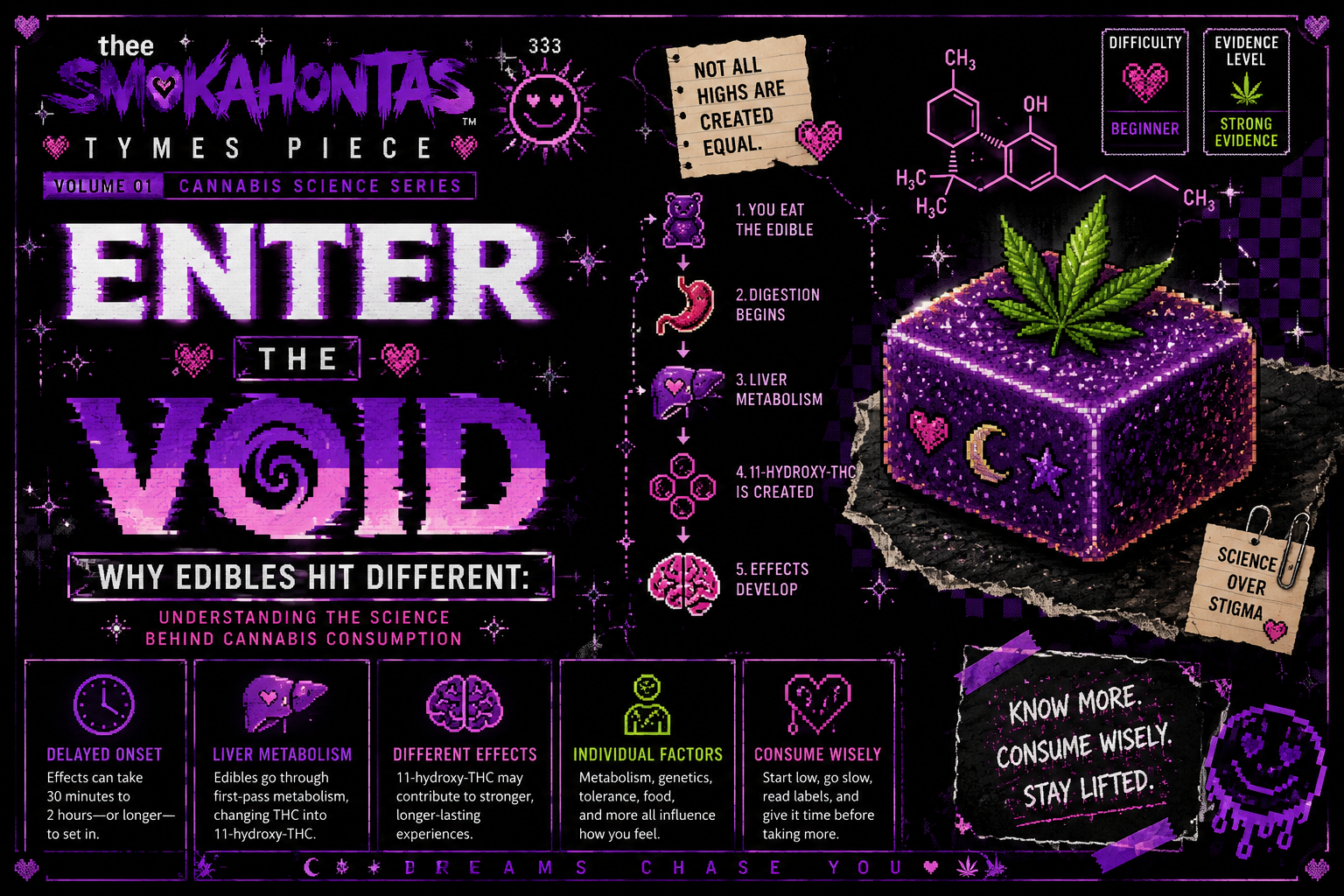
The Journey of an Edible
Step 1: Consumption
Unlike inhaled cannabis, an edible begins its journey in the digestive system. After swallowing, the product moves through the stomach and into the small intestine, where THC is absorbed.
Step 2: Digestion
The rate of digestion varies from person to person and can be influenced by factors such as recent meals, fat content, metabolism, and the specific product formulation. This is one reason onset times differ.
Step 3: The Liver Takes Over
Once absorbed, THC travels to the liver. Here, a significant portion undergoes first-pass metabolism, a process that transforms some delta-9 THC into 11-hydroxy-THC.
Step 4: A Different Metabolite
Research suggests that 11-hydroxy-THC contributes to the distinctive, longer-lasting psychoactive effects many consumers associate with edible cannabis. Although scientists continue to investigate its exact role, this metabolic pathway is widely recognized as a major difference between edible and inhaled cannabis.
Step 5: Effects Develop
Because digestion and liver metabolism take time, edible effects typically appear much later than inhaled cannabis. For many people, noticeable effects begin within 30 minutes to 2 hours, though this timeline can vary.
🔬 Research Spotlight
Studies on cannabinoid pharmacokinetics consistently show that orally consumed THC undergoes first-pass metabolism in the liver, producing 11-hydroxy-THC before reaching systemic circulation. This pathway helps explain why edible cannabis often produces a longer-lasting and subjectively different experience than inhaled cannabis.
Why Everyone's Experience Is Different
Even when two people consume the same edible, their experiences may not be identical.
Current research suggests that many variables contribute to these differences, including metabolism, digestive speed, genetics, tolerance, body chemistry, recent food intake, medications, and product formulation. Because these factors vary widely, cannabis affects individuals differently, making personalized expectations more realistic than universal assumptions.
Myth vs. Fact
Myth: Edibles are stronger because they contain more THC.
Fact: Products vary in THC content, but one major difference is how orally consumed THC is metabolized after passing through the liver.
Myth: If you don't feel anything after 20 minutes, you should take another dose.
Fact: Delayed onset is common with edible cannabis. Taking additional servings too quickly increases the likelihood of consuming more THC than intended.
Myth: Everyone experiences cannabis the same way.
Fact: Individual biology plays a significant role in how cannabinoids are absorbed, metabolized, and experienced.
My Perspective
Everything discussed so far has focused on current scientific understanding. What follows is simply my personal experience.
Over time, edibles became my preferred method of cannabis consumption because they provide a longer-lasting experience that fits my routine. I appreciate not needing to consume cannabis as frequently throughout the day, and I personally enjoy the gradual progression of effects once they begin.
That preference is not a recommendation for everyone. Another person may value the rapid onset and flexibility of inhaled cannabis. The goal isn't to identify a universally "best" method—it's to understand why different methods work differently and to choose the one that aligns with your own needs and preferences.
Key Takeaways
- The method of cannabis consumption influences onset, duration, and overall experience.
- Edible cannabis follows a unique digestive and metabolic pathway.
- First-pass metabolism converts some THC into 11-hydroxy-THC, contributing to the distinctive effects of edibles.
- Individual factors such as metabolism, tolerance, and recent meals influence the experience.
- Patience and careful dosing are important for responsible edible consumption.
Still Entering the Void...
Cannabis science continues to evolve. Researchers are actively studying how genetics, liver enzymes, the gut microbiome, and new edible formulations influence cannabinoid absorption and metabolism. While we know much more today than we did a decade ago, there is still much to discover about why cannabis affects each person so differently.
The more we learn, the better equipped we become to make informed, evidence-based decisions—one study at a time.
References
Centers for Disease Control and Prevention. Cannabis and Public Health. https://www.cdc.gov/cannabis/
Grotenhermen, F. (2003). Pharmacokinetics and Pharmacodynamics of Cannabinoids. Clinical Pharmacokinetics, 42(4), 327–360.
Huestis, M. A. (2007). Human Cannabinoid Pharmacokinetics. Chemistry & Biodiversity, 4(8), 1770–1804.
National Institute on Drug Abuse. Cannabis (Marijuana) DrugFacts. https://nida.nih.gov/
National Library of Medicine (PubMed). Peer-reviewed literature on edible cannabis pharmacokinetics and first-pass metabolism.